
News Release

Thermoplastic hybrid composite material combining dis-continuous and continuous fibers makes its debut at JEC World
~Jointly developed by TOYOBO MC, YUHO, and TOYOBO TEXTILE~
TOYOBO MC Corporation(hereinafter, “TOYOBO MC”) in collaboration with its wholly owned subsidiary YUHO Co., Ltd. (hereinafter, “YUHO”)and TOYOBO TEXTILE CO.,LTD.(hereinafter, “TOYOBO TEXTILE”) a member of the Toyobo Group, has developed a thermoplastic hybrid composite material that combines each company’s proprietary continuous fiber and dis-continuous-fiber composite technologies (hereinafter “the Developed Material”).
The Developed Material was exhibited for the first time at JEC World 2026, held in Paris, France, from March 10 to 12. By enabling rib molding that allows the formation of three-dimensional structures through integral molding, the Developed Material opens up new possibilities for applications of fiber-reinforced plastics.
1.Background of Development
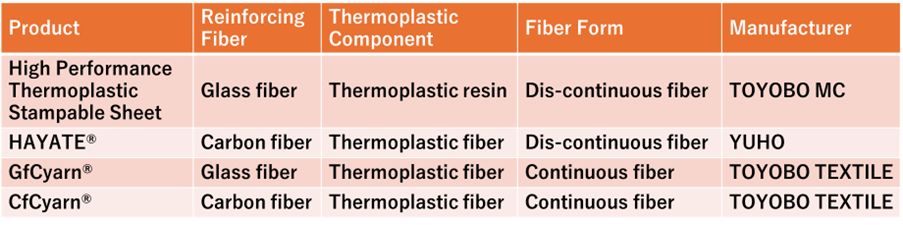
TOYOBO MC, YUHO, and TOYOBO TEXTILE each possess proprietary thermoplastic fiber-reinforced materials. Specifically, TOYOBO MC offers High Performance Thermoplastic Stampable Sheet,composed of glass fibers and thermoplastic resin; YUHO develops HAYATE®,a nonwoven fabric for carbon fiber reinforced thermoplastics; and TOYOBO TEXTILE provides GfCyarn®, a commingled yarn for glass fiber reinforced thermoplastics, as well as CfCyarn®), a commingled yarn for carbon fiber reinforced thermoplastics, both consisting of reinforcing fibers combined with thermoplastic fibers.
High Performance Thermoplastic Stampable Sheet and HAYATE® are composite materials utilizing dis-continuous fibers, while GfCyarn® and CfCyarn® are a commingled yarn utilizing continuous fiber (see table below). In general, composite materials based on dis-continuous fibers offer excellent formability* but tend to have limitations in flexural modulus. Conversely, continuous fiber composites exhibit high flexural modulus but face challenges in molding complex shapes.
Against this backdrop, TOYOBO MC, YUHO, and TOYOBO TEXITILE determined that combining these respective materials could enable the development of a product that achieves both high flexural modulus and superior formability. Through extensive joint evaluation and development efforts, the three companies have now successfully realized this thermoplastic hybrid composite material.
*Formability refers to the ability of a material to conform to a mold and be shaped into complex geometries as intended.
(Table) Characteristics of Thermoplastic Fiber-Reinforced Materials from the Three Companies
2.Overview of the Developed Material
①High Performance Thermoplastic Stampable Sheet × GfCyarn®
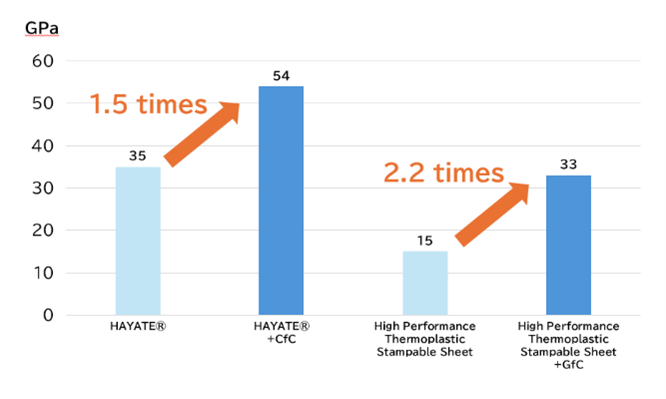
This developed material is molded by combining High Performance Thermoplastic Stampable Sheet, a composite material composed of glass fibers and thermoplastic resin, with GfCyarn®, a commingled yarn made of glass fibers and thermoplastic fibers.
Compared with the use of High Performance Thermoplastic Stampable Sheet alone, the flexural modulus of the developed material has been improved by 2.2 times (See the figure below on the right.).
② HAYATE® × CfCyarn®
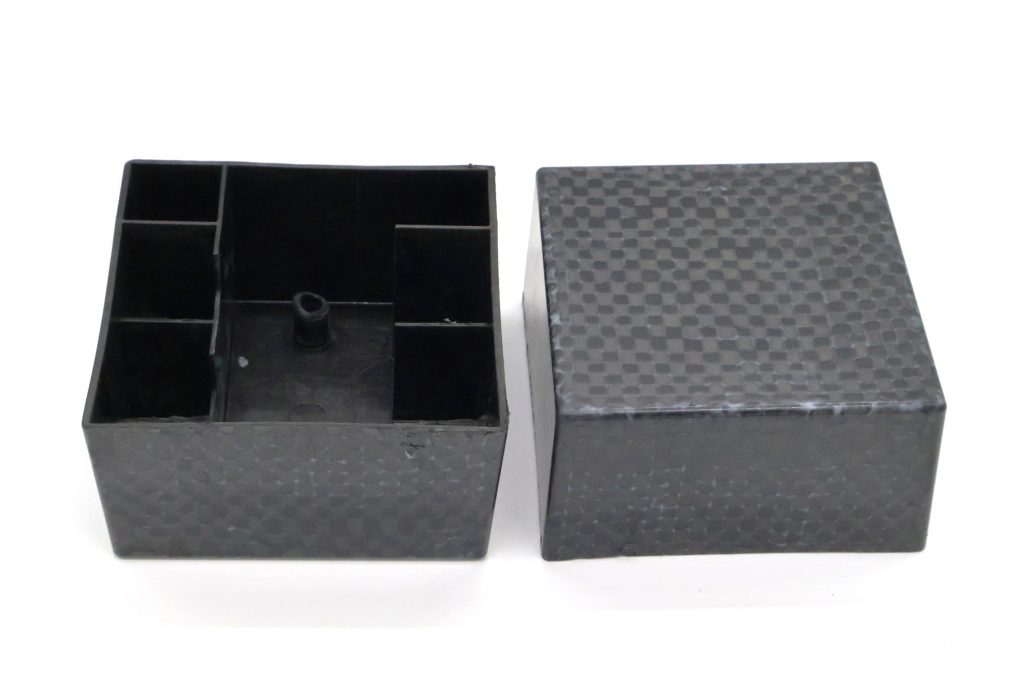
This developed material is molded by combining HAYATE®, a composite material consisting of carbon fibers and thermoplastic fibers, with CfCyarn®, a commingled yarn made of carbon fibers and thermoplastic fibers.Compared with the use of HAYATE® alone, the flexural modulus has been increased by 1.5 times (See the figure below on the right.). As shown in the photograph below, successful molding of a three-dimensional structure has been achieved.
3.Future Outlook
The developed material is expected to be applied in a wide range of fields, including automotive and civil engineering and construction applications.
TOYOBO MC will continue to contribute to solving challenges and creating new value across various industries through the development of high-performance composite materials.
<About the High Performance Thermoplastic Stampable Sheet>
This sheet is a random-oriented thermoplastic stampable sheet that combines excellent mechanical properties with superior moldability. High resin impregnation enables the material to exhibit outstanding strength, while its high flowability provides excellent formability. The material is currently used in applications such as toe caps for safety shoes.
<About the nonwoven fabric for carbon fiber reinforced thermoplastics “HAYATE®”>
HAYATE® is ,a nonwoven fabric for carbon fiber reinforced thermoplastics, made by blending carbon fibers with thermoplastic fibers. It can be molded into a variety of components through press forming. By converting carbon fibers into a nonwoven fabric while maintaining fiber length, the material achieves high strength, together with the excellent processability characteristic of thermoplastic composites. The use of recycled carbon fibers is also possible.
<About the commingled yarn for glass fiber reinforced thermoplastics “GfCyarn®” and the commingled yarn for carbon fiber reinforced thermoplastics “CfCyarn®”>
GfCyarn® and CfCyarn® are a commingled yarn that combine glass fibers and thermoplastic fibers (GfCyarn®), and carbon fibers and thermoplastic fibers (CfCyarn®), respectively, using proprietary yarn structures. As intermediate materials for thermoplastic glass-fiber and carbon-fiber composite materials, they are expected to be applied in fields such as aerospace, automotive, and civil engineering and construction materials.
The information presented in this news release is accurate as of the date of its announcement. Please be advised that the content may be subject to change without prior notice following the release date.
Link Collection





Contact
For inquiries about products and recruitment,
Please feel free to contact us here.